Use Your Loaf
In Defence of Bread: How History and Language Reveals Misinformation

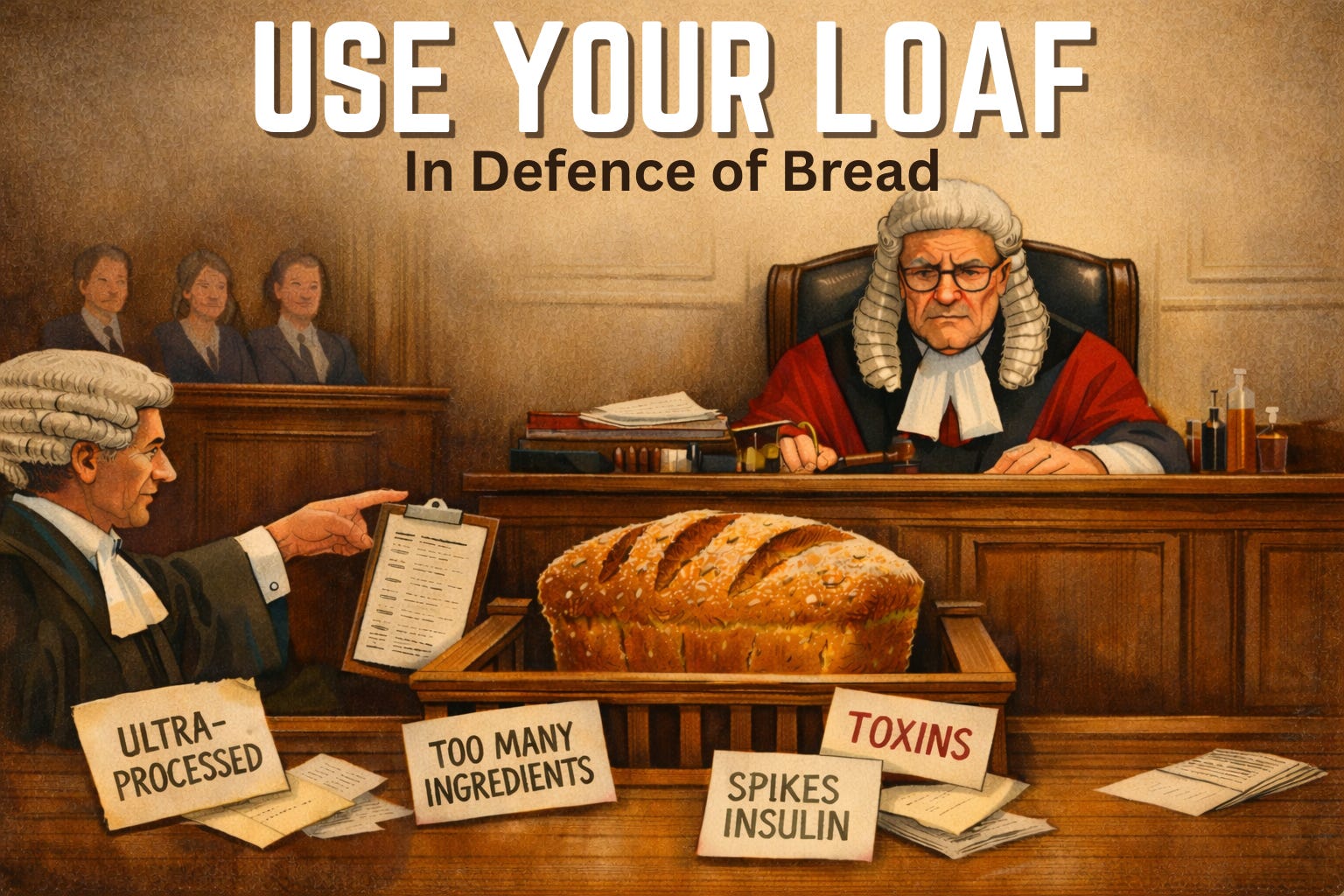
Bread gets a bad wrap*. Back in the nineties, during the anti-carb era when the Atkins diet was the dominant dietary ideology, I’d often hear people slating bread. Then things seemed to die down a bit and bread enjoyed a brief boost in popularity. But just when I thought bread loathing had been relegated to the past, TikTok and Instagram reels introduced a new wave of conflicting dietologies – many of the nutrition populism persuasion – and bread was back on the slicing board. This time, however, bread hostility isn’t just being spread by starch sceptics, but by grain-shunning carnivores and paleo diet advocates too. As well as this, bread hesitancy stems from the fact that many modern loaves contain more than four ingredients, a feature that places them neatly into the category of “ultra-processed food”.
If you’re unfamiliar with my work, you may not have come across “dietology”. In Well Fed: How modern diets are destroying us (and what we can do about it), I introduce the term. A portmanteau of “diet” and “ideology”, “dietology” refers to particular dietary beliefs that are based on ideology rather than evidence [1]. (Read more.)

Is there any merit to these bread-bashing fashions, or is bread fearmongering simply dietology?
More Than Four
Shop-bought breads, whether white, brown, wholemeal or seeded, are snubbed due to their long ingredient lists that include words that, it’s claimed, “your grandmother wouldn’t recognise”. On multiple podcasts and interviews, in several articles, like A Processed Mindset, Unprocessing the Ultra-Processed Mindset and Processing Terminology, and in Well Fed, I’ve voiced my objections to the flippant use of the term “ultra-processed food” and how the NOVA categorisation is used Bread provides a useful example to highlight the problem of classifying foods using labels.
Food conservatives assert that bread “should” be produced with just four ingredients: flour, water, salt and leaven (yeast). While the claim is a valid historical generalisation, most modern loaves include additional ingredients, such as preservatives, emulsifiers and added micronutrients. Preservatives boost a bread’s shelf life, allowing it to be stored for longer. This helps economies of scale in manufacture and efficiency in supply chains, helping to lower production costs, making bread cheaper to produce and more affordable for consumers.
Emulsifiers also help to prolong shelf life, but their key function is to aid the baking process enhancing the mouthfeel of the final product. Vitamins and minerals are added to make up for unavoidable losses from the grain during milling and baking, or because research-backed food policy recommends or mandates their inclusion, such as the fortification of flour with folic acid. These modern developments should be celebrated rather than demonised; being able to choose from a diverse range of pleasant and affordable breads with a longer shelf life is an all-too-often unappreciated marvel of modern science. While some brands add flavour enhancers, sweeteners and emulsifiers to enhance a loaf’s organoleptic qualities making it more enjoyable, there is a valid concern that encouraging overconsumption might contribute to weight gain with the associated health risks. Nevertheless, just because a loaf has more than four ingredients doesn’t mean that there’s anything unhealthy about it.
For some reason, sourdough breads seem to get a pass, successfully sidestepping much of the anti-bread fervour, at least from some dietological factions. Most sourdoughs only require an active starter, flour, water and salt in the baking process, and a sourdough loaf made with a strong flour and then covered and stored at room temperature can remain edible for a few days, negating the need for preservatives. Yet plenty of sourdough loaves are baked with more than four ingredients: some contain preservatives, vinegar and sugars. Such loaves might be referred to as “sourfaux”.
What History Tells Us
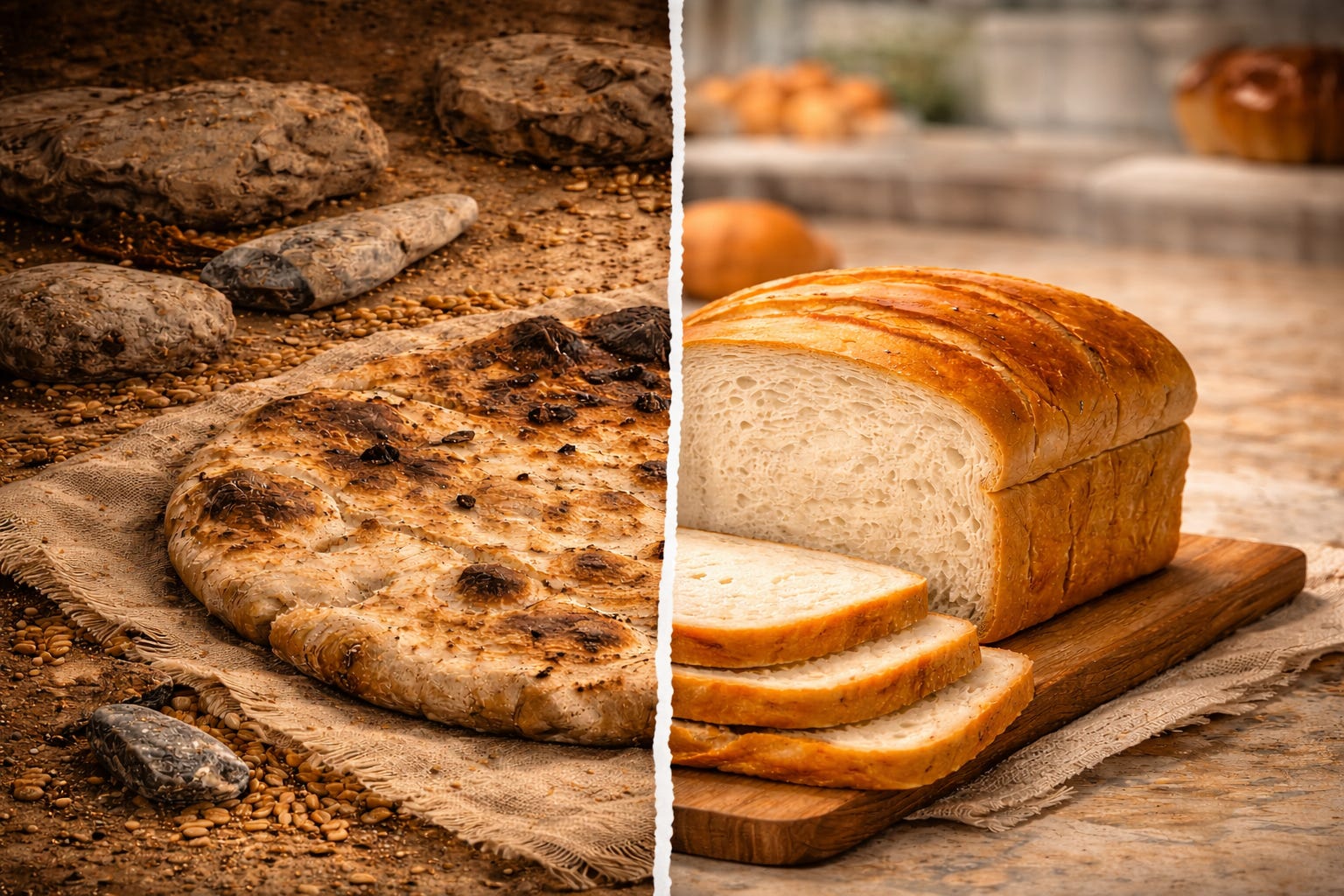
No one knows for certain when the first bread was eaten, but its essential role in society has existed since prehistoric times, predating farming. Evidence that our ancestors were grinding grains between stones – what we now call “milling” – dates back at least 30,000 years [2]. The oldest known bread has origins around 14,500 years ago, discovered in Jordan’s northeastern desert [3]. The first leavened bread – using yeast to make it rise – is credited to Mesopotamians as early as 6,000 BCE [4], though bread-making didn’t really take off until the ancient Egyptians started baking around 5,000 years ago [5]. Early breads were dense, rustic flatbreads, likely very different to the puffed-up loaves we enjoy today. By the peak of ancient Egypt and during the Roman Empire, bread was firmly a staple of most people’s diet.
Even the Ancient Greeks and Romans were making multiple varieties of bread by incorporating additional ingredients like honey, oils or seeds [6]. And during the Middle Ages, people were baking with more than the main four, such as eggs, milk, butter and a range of spices, to aid in flavour and shelf life [7].
Bread fortification began in the 1940s as a strategy to combat malnutrition [8], and the Chorleywood process in 1961 revolutionised mass production, by using emulsifiers, fats and enzymes to amplify production and extend shelf life [9].
What Language Tells Us
Early word lists compiled by Anglo-Saxon monks reveal a number of bread-related references. Breadru, for instance, translates Latin frustra meaning “bits, pieces, morsels”, and manna, found in the bible, is translated by the phrase heofenlic hlaf: “heavenly bread”. Today, the word hlaf would be recognised as loaf, as the h stopped being pronounced at the end of the Anglo-Saxon era, and the long “ah” sounds morphed into “oh” during the Middle Ages [10].
Bread’s importance is illustrated by Old English terms. The head of a household was known as a hlaf-weard (“bread-warden”), i.e. the individual who provides bread for everyone. A hlaf-œta (“bread-eater”) was the term for a dependent, and a hlœfdige (“bread-kneader”) was a lady – the -dige ending evolved into “dough”. During the 14th century, hlaf-weard morphed first into something that sounded like “lahrd”, then to “laird” in Scotland and eventually to “lord”, giving us a modern English term related to high status that has its origins in humble bread [11].
The prominence of bread is also demonstrated in religion. Hlaf, for instance, is found in a number of Christian settings, such as hlaf-mœsse (“loaf-mass” became Lammas, the first day when eucharistic bread was baked from the harvest), hlaf-gang (“bread-going”, walking to the altar to receive communion), and hlaf-hus (“house of bread”: Bethlehem, where Jesus was born) [12].
In modern English, the word “bread” is used for much more than foodstuffs, as reflected in a range of compound words and idioms, such as breadwinner and give us this day our daily bread. Cockney rhyming slang has supplied “bread” to mean “money” (from bread and honey) and “loaf” for “head” (from loaf of bread). It can identify a state of mind, as in knowing on which side one’s bread is buttered, or how we rate something: the best things since sliced bread. The term to break bread is to sit and share a meal and to reconcile past ill feelings.
What bread’s history and the etymology of bread-associated terms tell us is that the impact of bread as a staple in human diets has been so huge that its influence stretches to non-food-related language, religion and hierarchy. Bread has been crucial to human physical, social and cultural evolution for millennia.
What Genetics Tells Us
Another common claim made by bread bashers is that Homo sapiens aren’t evolved to digest large amounts of starchy carbs. But if humans aren’t supposed to consume much starch, how do we explain the AMY1 gene?
Starch digestion involves the enzyme amylase, secreted both in saliva and from the pancreas. Amylase breaks down the long polysaccharide chains that make up starch to the disaccharide maltose, which, further along the alimentary canal, is itself broken down into two molecules of glucose. Glucose is the form of energy preferred by our brains and bodies, and starchy foods are a predominant feature of the vast majority of people’s diets across the globe, whether from rice, corn, wheat, potatoes or other cereals.
The number of copies of the AMY1 gene – which codes for salivary amylase – varies across populations and individuals. The more copies of the AMY1 gene that are expressed, the more salivary amylase is present and the more efficiently someone is able to break down starch [13]. Populations who grew to depend more and more on growing their calories in the form of cereals and grains benefited from a mutation where more AMY1 was expressed. With more salivary amylase present, more starch can be hydrolysed in the mouth, making it easier to extract its valuable calories. This mutation proved beneficial for our forebearers as they became increasingly dependent on starch for nourishment. Those with the ability to digest starch more effectively benefited and had a reproductive advantage.
Fibre Opportunity
The health benefits of fibre are well-known [14], yet most of us aren’t consuming anywhere nearly enough. Only nine per cent of UK adults get the recommended 30 grams per day, with most failing to meet the amount a five-year-old needs [15]. In the US, only five per cent of men and nine per cent of women are getting sufficient amounts [16]. Moreover, studies have shown that fibre-rich wholegrains are associated with a lower risk of chronic disease [17].
Wholegrain breads can be really useful for bumping up your fibre intake. In the UK, bread contributes 17 to 21 per cent of daily fibre intake [18], and in the US, it makes up roughly 12 per cent [19]. I opt for wholemeal or seeded breads where possible. I do, on occasion, eat other types, but when the only breads available are white, I see it as a lost opportunity to consume beneficial fibre.
Food Fearmongering
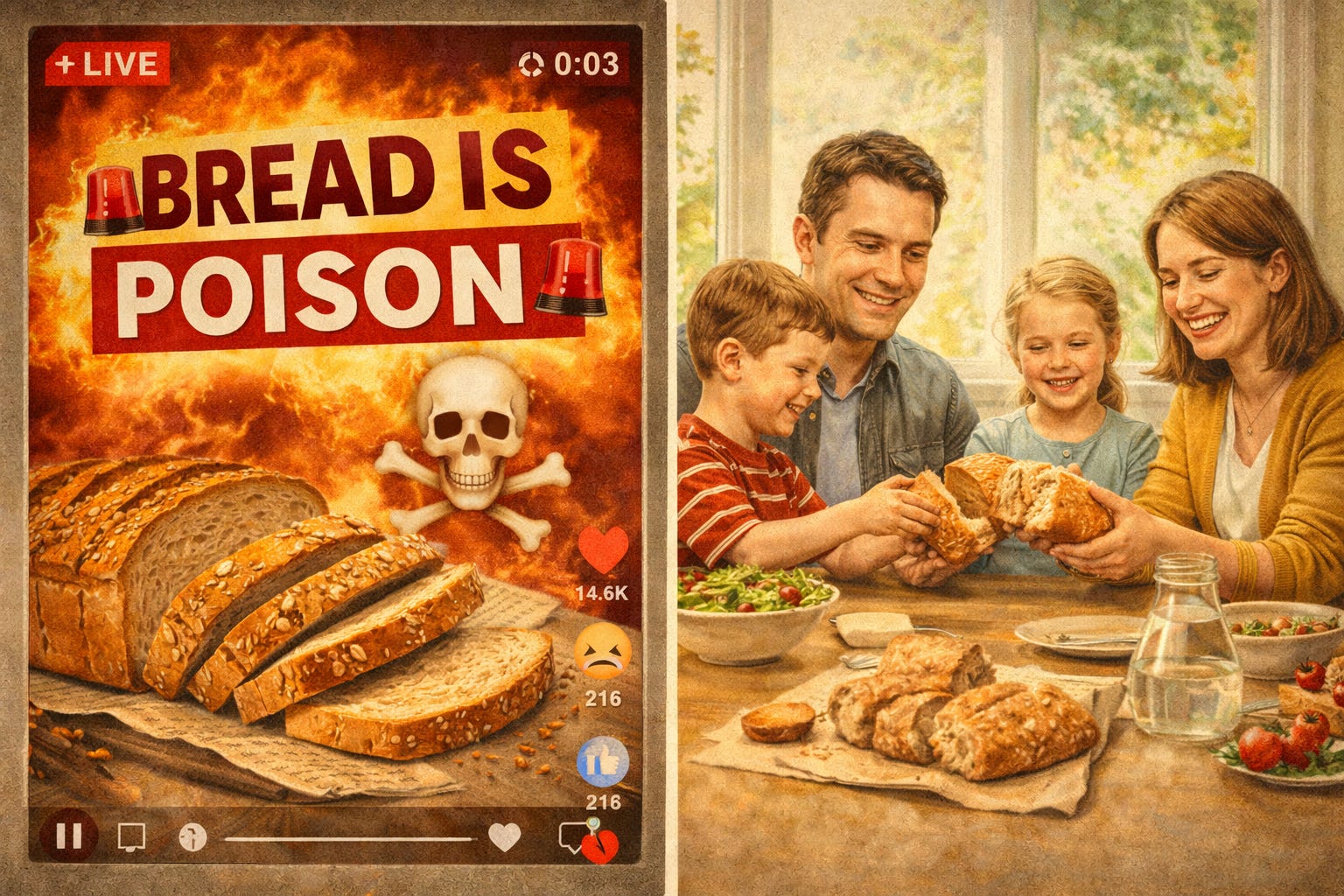
Influencers whose content involves fearmongering foods – such as by claiming that a food “contains toxins”, “causes inflammation” or “spikes insulin” – seek only to prompt outrage through clickbait. Whether they do so for financial gain, to gain notoriety or to push their nutrition ideology, this type of content is potentially dangerous. These folk don’t care if they’re promoting disordered eating, pushing suboptimal diets, encouraging less sustainable eating or confusing their audience. And they’re oblivious to the fact that by posting scaremongering content, they’re displaying their lack of awareness of any historical, cultural and real-world significance of the foods they’re dissing. The bread example exposes this detachment from reality.
Bread is by no means essential in most modern societies, at least from a nutritional point of view. But, by exploring bread’s history and etymology, we can demonstrate the futility of bread fearmongering. Even my very brief summary reveals how the flippant denigration of bread fails to acknowledge the integral role bread has had in human cultural – and physical – evolution.
In the same way that anti-bread dogma is based on little more than ideology, we can apply this mindset to other foods and dietary patterns. When you come across someone vilifying any food, demand evidence for their assertion, and be mindful that the food in question might have a protracted history and significant cultural relevance. Rather than accepting what you hear, pause and ponder that there’s likely a lot more to the food. Use your loaf!
* I couldn’t resist an early pun!
Notes & References:
1. Collier, J. (2025) Well Fed: How Modern Diets Are Failing Us (and What We Can Do About It). London: Thorsons, p30.
2. Revedin, A. et al. (2010) ‘Thirty Thousand-Year-Old Evidence of Plant Food Processing’, Proceedings of the National Academy of Sciences, 107(44), 18815-19.
3. Arranz-Otaegui, A. et al. (2018) ‘Archaeobotanical Evidence Reveals the Origins of Bread 14,400 Years Ago in Northeastern Jordan’, Proceedings of the National Academy of Sciences, 115(31), 7925-30.
4. Paulette, T. (2020) ‘Fermentation in Ancient Mesopotamia, Beer, Bread, and More Beer’, Fermentology, 18 June. Available at: https://fermentology.pubpub.org/pub/ae89zkf2/release/1 (Accessed: 4 April 2026).
5. Samuel, D. (1994) An Archaeological Study of Baking and Bread in New Kingdom Egypt. PhD thesis. University of Cambridge. Available at: https://www.repository.cam.ac.uk/items/900e5220-60cf-47b3-b640-3126121cf5cf (Accessed: 4 April 2026).
6. (a) Monaco, F. (2018) ‘Baking Bread with the Romans: Part IV – An Ancient Roman Recipe for Cato’s Grape Must Cakes (Mustacei)’, Tavola Mediterranea, 22 September. Available at: https://tavolamediterranea.com/2018/09/22/baking-bread-romans-part-v-grape-must-cakes/ (Accessed: 4 April 2026); (b) Chrysopoulos, P. (2026) ‘The 72 Breads of Ancient Greece You’ve Never Heard Of’, Greek Reporter, 31 January. Available at: https://greekreporter.com/2026/01/31/ancient-greek-bread/ (Accessed: 4 April 2026).
7. Medievalists.net (2024) ‘Bread in the Middle Ages’, 6 March. Available at: https://www.medievalists.net/2024/03/bread-middle-ages/ (Accessed: 4 April 2026).
8. BakeryBits (2023) ‘So What Is Flour Fortification in the UK?’, 25 January. Available at: https://www.bakerybits.co.uk/bakers-blog/what-is-flour-fortification (Accessed: 4 April 2026).
9. BBC News (2011) ‘Chorleywood: The Bread That Changed Britain’, 7 June. Available at: https://www.bbc.co.uk/news/magazine-13670278 (Accessed: 4 April 2026).
10. Crystal, D. (2011) The Story of English in 100 Words. Profile Books, pp10-13.
11. ibid (10).
12. ibid (10).
13. (a) Perry, G. et al. (2007) ‘Diet and the Evolution of Human Amylase Gene Copy Number Variation’, Nature Genetics, 39, 1256-60; (b) Mandel, A. L. et al. (2010) ‘Individual Differences in AMY1 Gene Copy Number, Salivary α-Amylase Levels, and the Perception of Oral Starch’, PLOS ONE, 5(10), e13352; (c) Carpenter, D. et al. (2017) ‘Copy Number Variation of Human AMY1 Is a Minor Contributor to Variation in Salivary Amylase Expression and Activity’, Human Genomics, 11, 2.
14. Examples: (a) Chen, J.-P. et al. (2017) ‘Dietary Fiber and Metabolic Syndrome: A Meta-Analysis and Review of Related Mechanisms’, Nutrients, 10(1), 24; (b) Barber, T. M. et al. (2020) ‘The Health Benefits of Dietary Fibre’, Nutrients, 12(10), 3209; (c) Ramezani, F. et al. (2024) ‘Dietary Fiber Intake and All-Cause and Cause-Specific Mortality: An Updated Systematic Review and Meta-Analysis of Prospective Cohort Studies’, Clinical Nutrition, 43(1), 65-83.
15. (a) British Nutrition Foundation (2023) Fibre. Available at: https://www.nutrition.org.uk/nutritional-information/fibre/ (Accessed: 4 April 2026); (b) Kehoe, L. et al. (2023) ‘Food and Nutrient Intakes and Compliance with Recommendations in School-Aged Children in Ireland: Findings from the National Children’s Food Survey II (2017–2018) and Changes Since 2003–2004’, British Journal of Nutrition, 129(11), 2011-24; (c) Boyle, N. B. et al. (2024) ‘Increasing Fibre Intake in the UK: Lessons from the Danish Whole Grain Partnership’, British Journal of Nutrition, 131(4), 672-85.
16. ASN Staff (2021) ‘Most Americans Are Not Getting Enough Fiber in Our Diets’, American Society for Nutrition, 9 June. Available at: https://nutrition.org/most-americans-are-not-getting-enough-fiber-in-our-diets/ (Accessed: 4 April 2026).
17. Examples: (a) Aune, D. et al. (2016) ‘Whole Grain Consumption and Risk of Cardiovascular Disease, Cancer, and All Cause and Cause Specific Mortality: Systematic Review and Dose–Response Meta-Analysis of Prospective Studies’, BMJ (Clinical Research Ed.), 353, i2716; (b) Benisi-Kohansal, S. et al. (2016) ‘Whole-Grain Intake and Mortality from All Causes, Cardiovascular Disease, and Cancer: A Systematic Review and Dose-Response Meta-Analysis of Prospective Cohort Studies’, Advances in Nutrition, 7(6), 1052-65.
18. Lockyer, S. and Spiro, A. (2020) ‘The Role of Bread in the UK Diet: An Update’, Nutrition Bulletin, 45(2), 133-64.
19. (a) Hoy, M. K. and Goldman, J. D. (2014) ‘Fiber Intake of the U.S. Population’, Food Surveys Research Group Dietary Data Brief, 12. Available at: https://www.ars.usda.gov/arsuserfiles/80400530/pdf/dbrief/12_fiber_intake_0910.pdf (Accessed: 4 April 2026); (b) Ribet, L. et al. (2025) ‘The Nutritional Contribution and Relationship with Health of Bread Consumption: A Narrative Review’, Critical Reviews in Food Science and Nutrition, 65(28), 5698-725.