Stop Using “Evidence-Based”!
And the Tautology of “Evidence-Based Science”

Do you have a favourite food and nutrition influencer? You’re spoiled for choice, with health-related content popping up whenever you scroll. But have you ever pondered what it is about your prized prophet’s material that draws you in? Crucially, have you considered whether the information they share is credible?
Sadly, much of what we watch is more pseudoscientific rhetoric than useful advice based on evidence. Online clickbait has made it easy to be lured in by creators who blurt out unrealistic, polarising or even dangerous information. When intellectual rigour is absent from someone’s agenda, they can rapidly create content. Why be bogged down with the burden of having to fact-check everything? Just whip out your phone, record yourself saying whatever’s in your head and upload it to your socials. Research ignored. Easy-peasy. Job done. But even worse than creators who don’t care about evidence are the charlatans who cite research but lazily or purposely misrepresent it, cherry-picking data to back up their narrative. This troubling trend makes it understandable that genuine experts and credible content-makers want to make their profiles stand out from the crowd.
I used to include the phrase “evidence-based” in my social media profiles. I displayed the term to signal that the information I was sharing was based on sound research, to distinguish myself from the uninformed opinions doled out by quacks. Indeed, I’ve noticed numerous other accounts also include this descriptor. However, a while back I removed the term. Why?
Suboptimal Slogans
While attending the Nutrition Society Winter Conference in January, I noticed their slogan: “The home of evidence-based nutritional science”. I’m not sure how long the Society has had this tagline, but it was only during the event that it dawned on me that the phrase is a tautology.
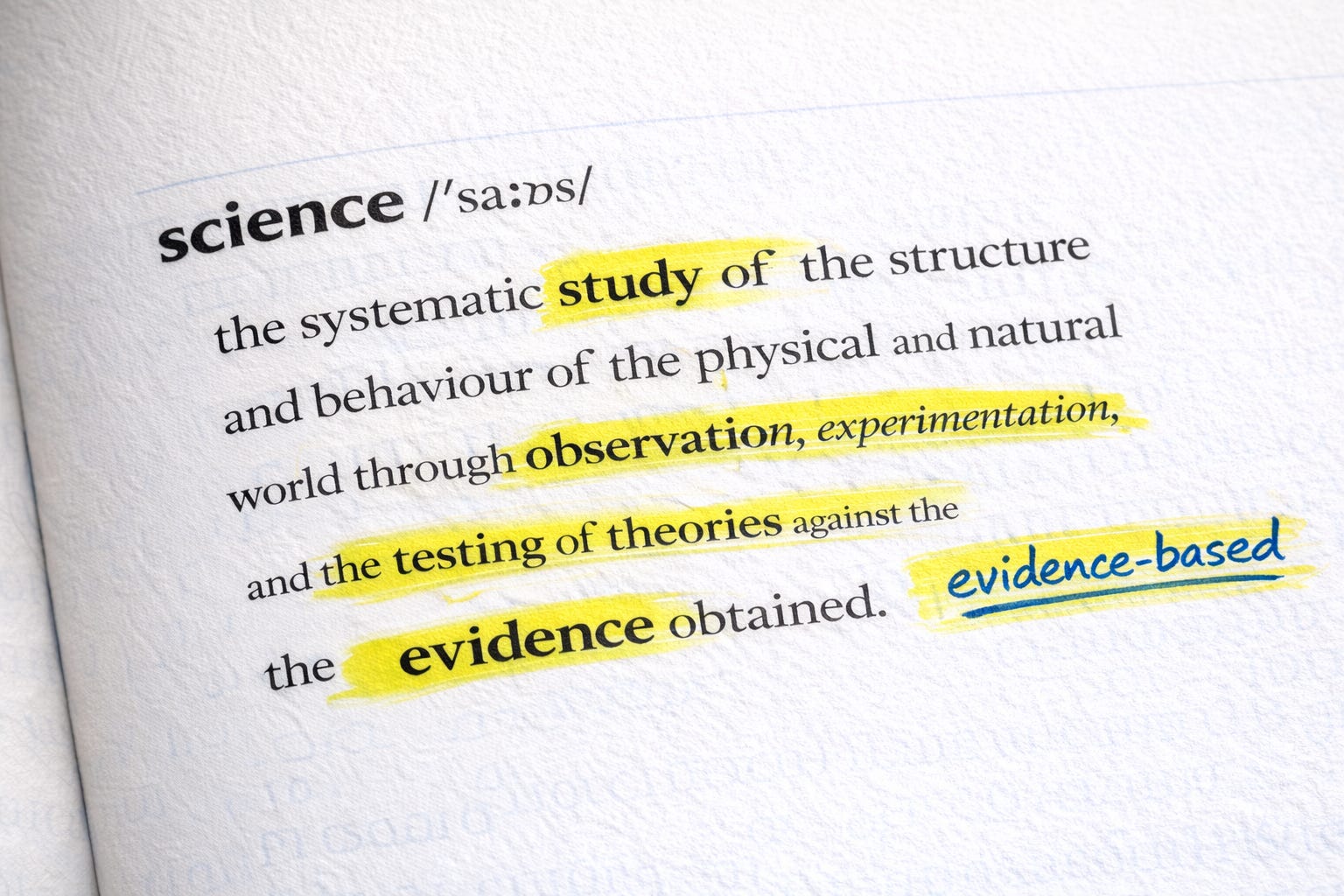
The term science is defined by Google (via Oxford Languages) as:
the systematic study of the structure and behaviour of the physical and natural world through observation, experimentation, and the testing of theories against the evidence obtained [1].
By the Oxford English Dictionary as:
a branch of study dealing with a body of facts or truths systematically arranged and showing the operation of general laws, particularly obtained and tested through the scientific method [2].
And by Merriam-Webster:
knowledge or a system of knowledge covering general truths or the operation of general laws especially as obtained and tested through scientific method [3].
I opened a previous article with a description of science that I’m particularly fond of: “Science is the continual pursuit of the truth while being content in the knowledge that you’ll not find it”. I also cited Thomas Kuhn: “Science doesn’t march steadily towards truth, but advances through conceptual models – theories – that change, not only through evidence, but also through social forces” [4].
What all these definitions and descriptions have in common is that they include terms like “study”, “experimentation”, “testing”, “theories”, “truth” and “evidence”. There’s also reference to the scientific method, the tool that humans use to test hypotheses and draw conclusions (discussed in Nutrition and Enlightenment Values). Evidence is part of the scientific method.
The Nutrition Society’s slogan is tautological because it includes both “evidence-based” and “science”. The former is superfluous and devalues the latter. By its very definition, the scientific method requires empirical evidence to formulate, test and validate hypotheses. If something isn’t based on evidence, it simply isn’t science. I make this criticism as a member and ardent supporter of the Society and what it stands for – i.e. championing high-quality research in nutrition. But it’s an important point as science involves challenge, and this is, after all, just my opinion. The reason why institutions have slogans is to succinctly highlight their roles and values. A slogan should, therefore, be wholly resonant.
Tautologies are generally considered poor style because they are uninformative, provide no new information and violate communication norms. Granted, some folk might argue that they add strength to a statement when one part serves to affirm the other, and they can be integral to critical thinking [5]. However, this has more relevance to their use in assertions or debates. When a tautology is present in a snappy phrase, it risks devaluing it.
Devaluing Descriptions
In this era of persuasive health conspiracism, words like “truth” and “fact” don’t necessarily point to objective reality. Just because someone claims they’re sharing “the truth” or “facts” doesn’t mean what they’re saying is true or factual. Likewise, when someone describes himself as “trustworthy” or “honest”, it doesn’t prove that they are trustworthy or honest. After all, no influencer, whatever his experience or educational background, thinks he lacks credibility. Even the most confident, science-shunning zealot believes he’s a reliable source of information and will frequently use words like “truth” and “fact”.
The same applies to “evidence”. When qualified and experienced nutritionists and dietitians include “evidence-based” in their profiles, it risks making them appear to lack confidence, devaluing their credibility. It’s an unnecessary barrier that inhibits the bona fide from shining bright.
Science is opinion and opinions can be plucked out of thin air. But credible opinions are based on evidence. The acquisition of evidence is progressive, meaning that opinions will be formed via different routes. We are all subject to different information: we read different papers, articles and books and we watch different videos. Consequently, we may arrive at different interpretations of evidence. And when we add in our own real-world experience, opinions will be diverse. Even the most acclaimed expert will, at times, be wrong. It’s how they respond when they discover their error that’s testament to their authenticity. This is why, when confronted with a serious medical condition – as, sadly, many of us will be at some point – we should seek a second, or even third, opinion. Science is a fluid process: our quest for the truth is reliant on the synergy of opinions built from ongoing evidence and experience.
Anecdotes might hold little clout in scientific circles, but they can be incredibly useful tools, as real-life experiences often resonate better with audiences. The use of anecdotes should be embraced, as long as they’re conveyed honestly and transparently. Proclaiming to be “evidence-based” makes using them tricky.
Using the term “evidence-based” to describe one’s material is both nonsensical and devaluing. When someone’s content includes honest citations of research, the fact that they’re an evidenced-based creator will be self-evident, negating the need for the descriptor. Credibility will be apparent from the quality of the content and the honest way in which it’s communicated.
Stand Out
I get it – credible health commentators are up against tough competition: those super-charismatic mountebanks who’ve amassed millions of followers by providing bite-sized, compelling content. It feels like we should utilise every means necessary to drown out their misinformation. If you’re a health commentator, this world of fake news and pseudoscience might tempt you to use “evidence-based” to double down on your credibility. Yet, proclaiming to be “evidence-based” risks opening you up to criticism when you later have to back-track as you discover new evidence; and, rest assured, if you’re someone who values evidence, there will be times when you’re forced to course-correct.
Ethical content makers have to be held to the highest of standards. I say this as I aspire to be a member of this select group. I share this criticism with the utmost respect and do so only because I champion those who produce high-quality content. I want them to stand out during a time when we need them more than ever. I want you to stand out.
References:
1. Google and Oxford Languages (n.d.) Science. Available at: https://www.google.co.uk/search?q=define%3A+science (Accessed: 2 March 2026).
2. Oxford English Dictionary (2014) Science, n. Available at: https://www.oed.com/dictionary/science_n (Accessed: 2 March 2026).
3. Merriam-Webster (2026) SCIENCE Definition & Meaning. Available at: https://www.merriam-webster.com/dictionary/science (Accessed: 2 March 2026).
4. (a) Collier, J. (2025) ‘The Rise of Nutrition Populism - Part 2’, Substack, 26 November. Available at: https://substack.com/@jamescollierrnutr/p-179811958 (Accessed: 2 March 2026); (b) Kuhn, T. S. (1962) The Structure of Scientific Revolutions. Chicago, IL: University of Chicago Press.
5. Patterson, S. (2015) ‘Tautologies Must Not Be Dismissed’, Steve Patterson, 13 December. Available at: https://steve-patterson.com/tautologies-must-not-be-dismissed/ (Accessed: 2 March 2026).